
Research Foundations
The Story Learning Lab© approach is informed by research in language acquisition, cognitive psychology, motivation and narrative learning. Stories place new vocabulary within meaningful contexts, allowing learners to encounter, use and revisit language while engaging with characters, events and ideas.
The approach draws particularly on the work of:
Lev Vygotsky – learning through social interaction, guided participation and the Zone of Proximal Development
Jerome Bruner – narrative as a structure for organising experience and constructing meaning
Stephen Krashen – comprehensible input and the importance of a supportive, low-anxiety learning environment
Richard Schmidt – noticing and attention to language features within meaningful activity
Fergus Craik and Robert Lockhart – the levels-of-processing framework, highlighting how semantic processing and elaboration can support more durable memory than attention to surface features alone
Allan Paivio – dual coding through meaningfully coordinated verbal and visual information
Paul Nation – vocabulary development through repeated, contextualised encounters and meaningful use
Henry Roediger and Jeffrey Karpicke – retrieval practice as a means of strengthening long-term retention
Edward Deci and Richard Ryan – autonomy, competence and relatedness as conditions supporting motivation and sustained engagement
Together, these principles informed the design of the teacher-guided, personalised storytelling activities used within Story Learning Lab™. By contributing ideas, encountering and retrieving target vocabulary in meaningful contexts, and actively discussing their stories, learners become participants in the learning process rather than simply recipients of information.
Jerome Bruner
Lev Vygotsky
Edward Deci and Richard Ryan
Craik and Lockhart
Jean Piaget
Key Theorists Informing Story Learning Lab ©
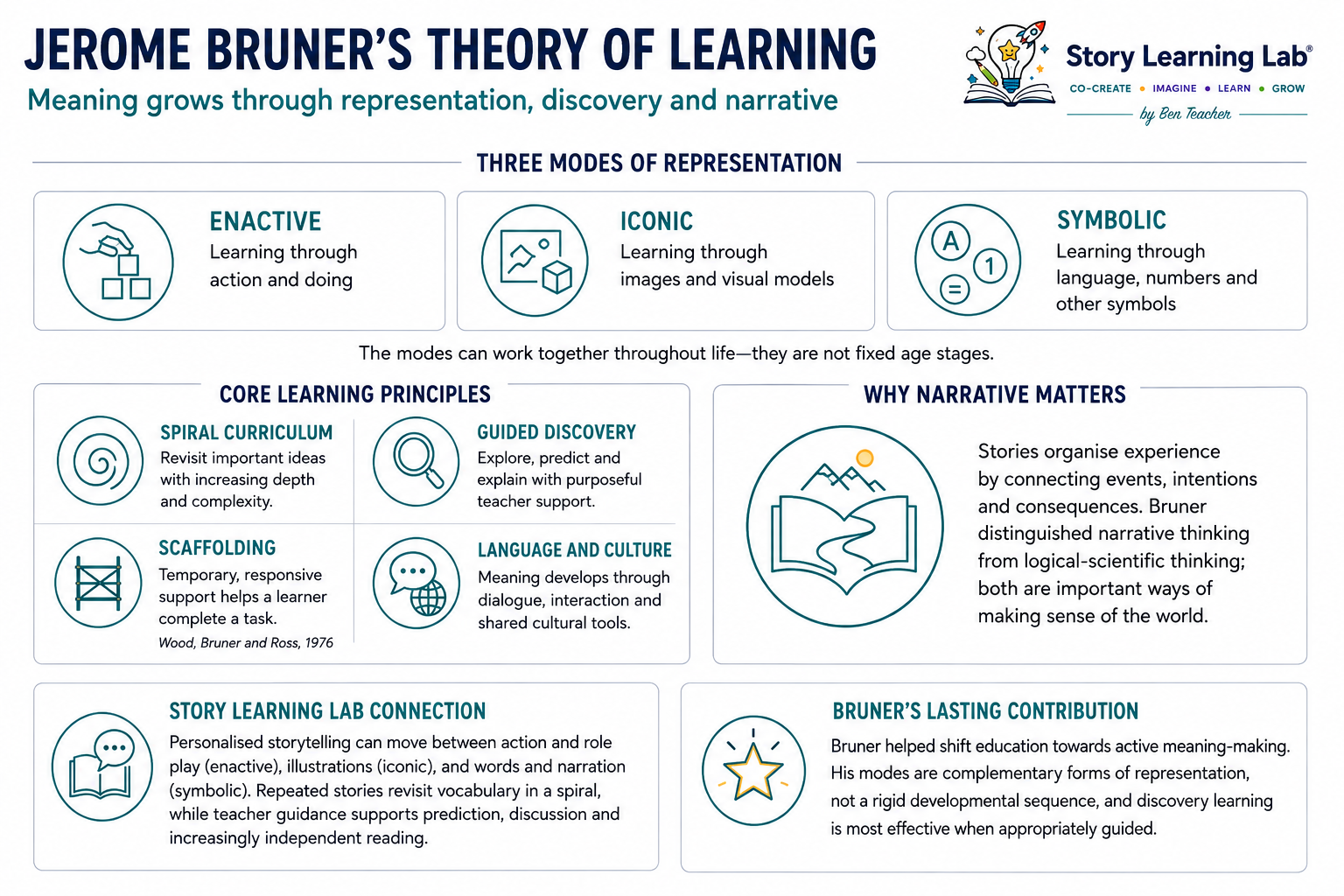
Bruner described learning through enactive, iconic and symbolic forms of representation and highlighted guided discovery, the spiral curriculum and narrative meaning-making.
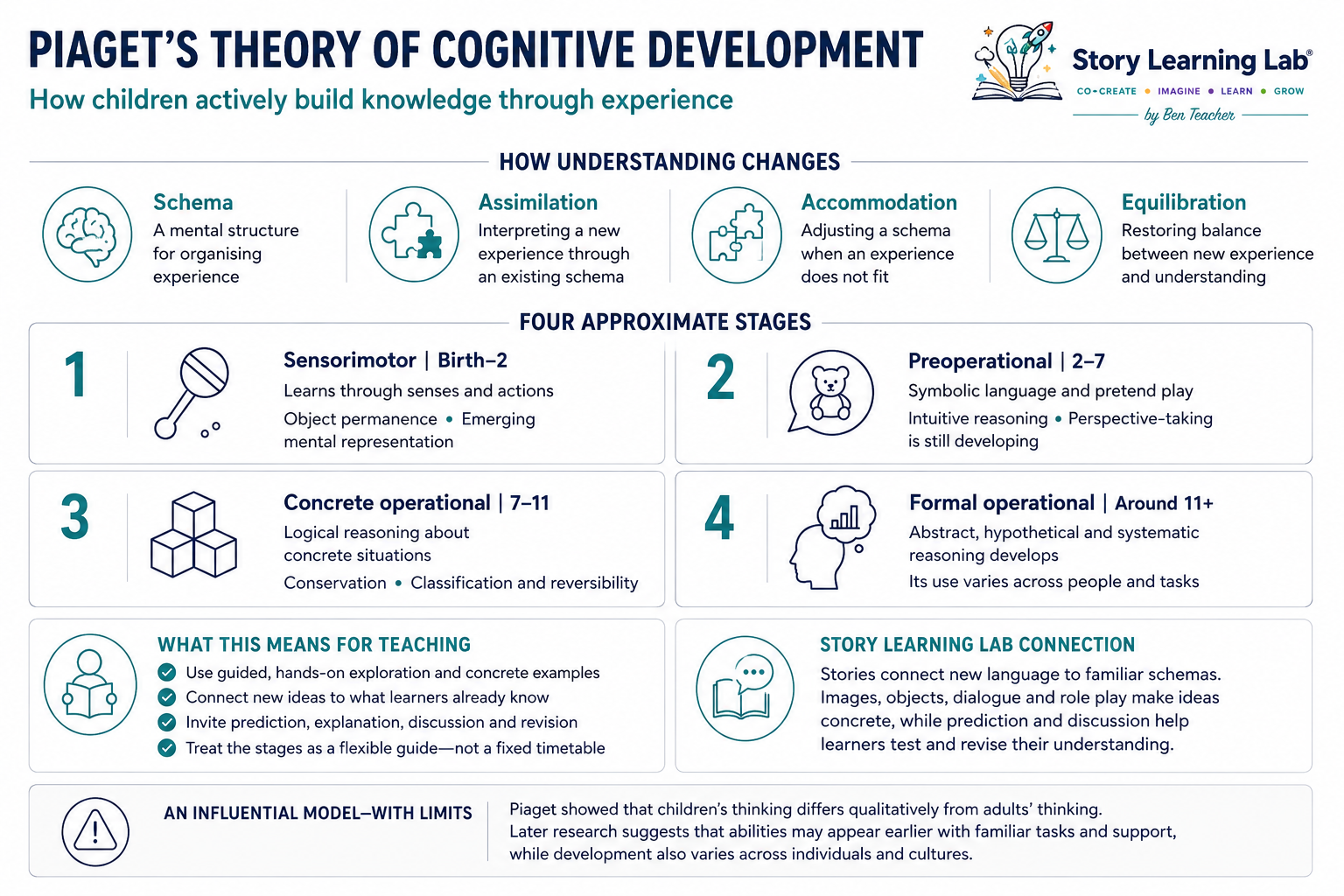
Piaget proposed that children actively construct knowledge by adapting mental schemas through assimilation and accommodation.
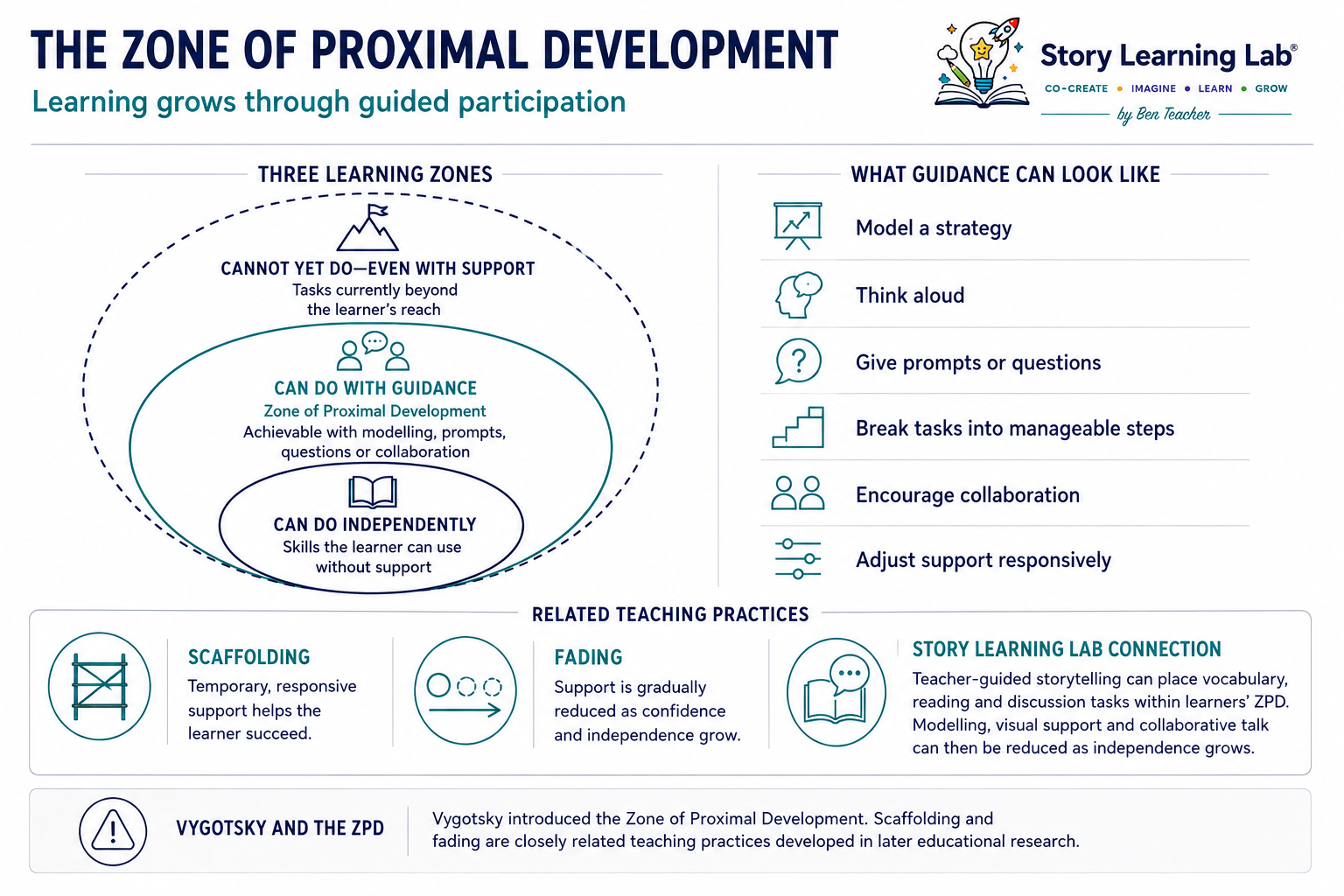
Vygotsky emphasised that learning develops through social interaction and guided participation within the Zone of Proximal Development (ZPD) - the space between independent performance and what can be achieved with support.
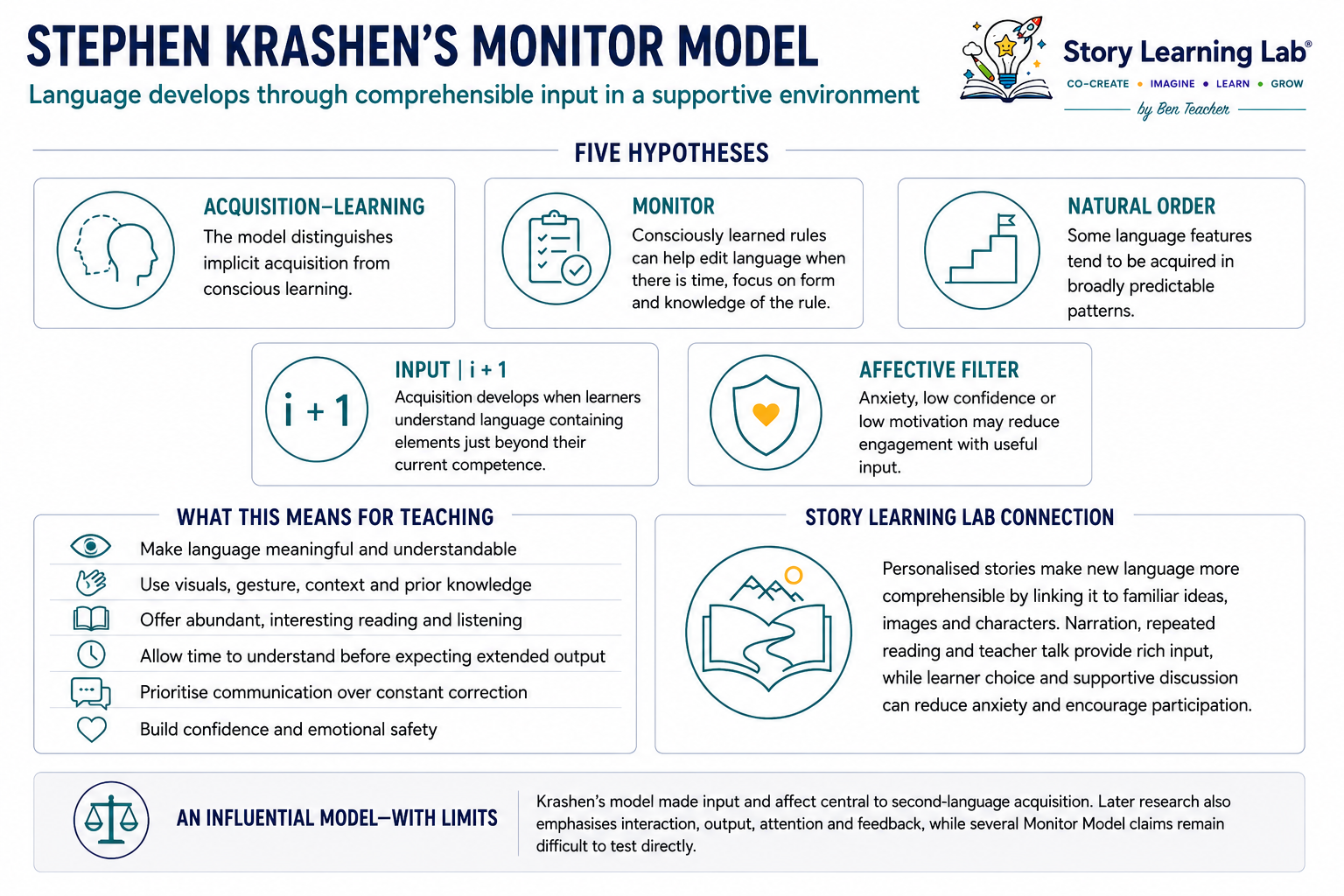
Krashen emphasised that second-language acquisition develops through abundant comprehensible input in a supportive, low-anxiety environment.
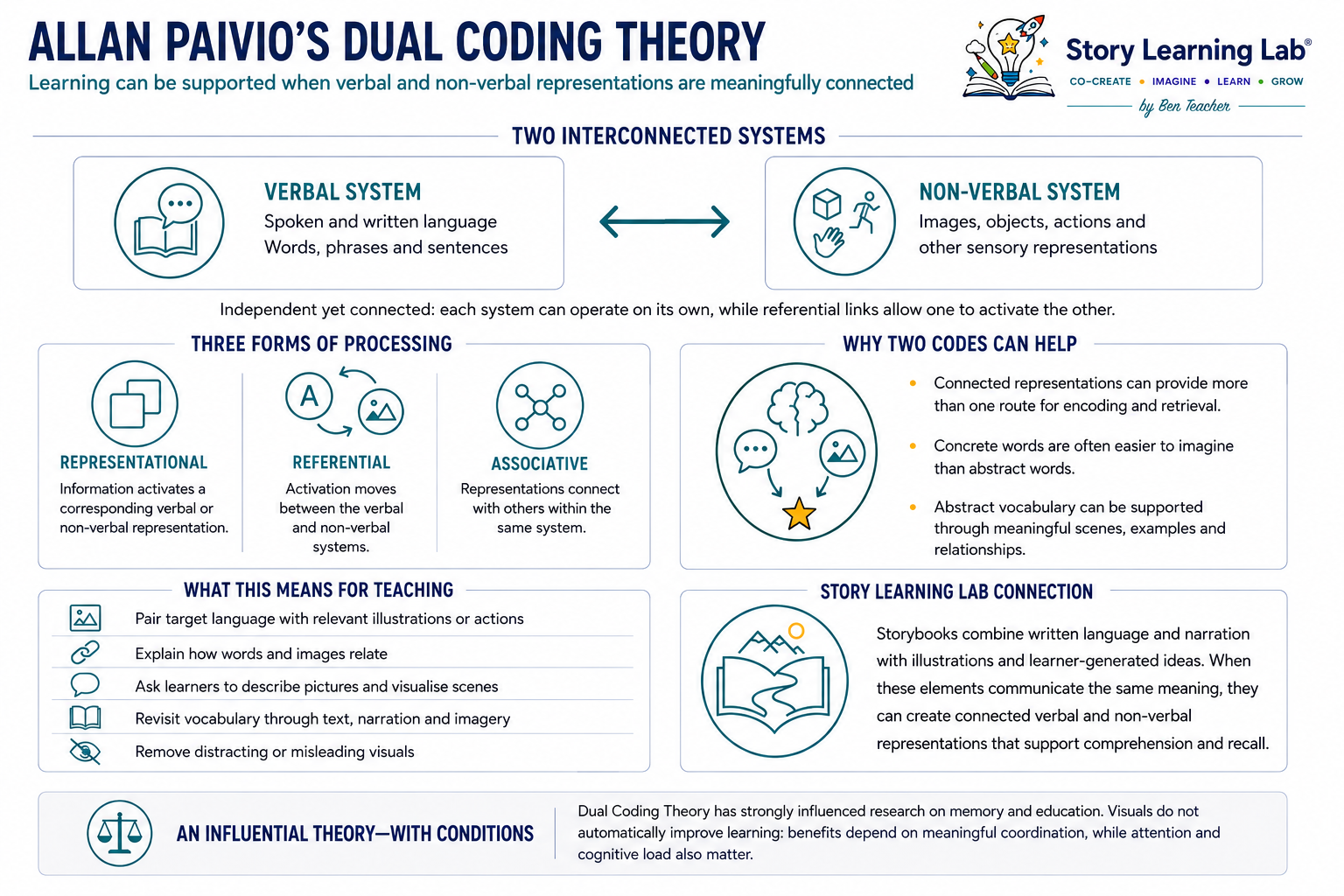
Paivio’s Dual Coding Theory proposes that verbal and non-verbal information is represented through distinct but interconnected systems.
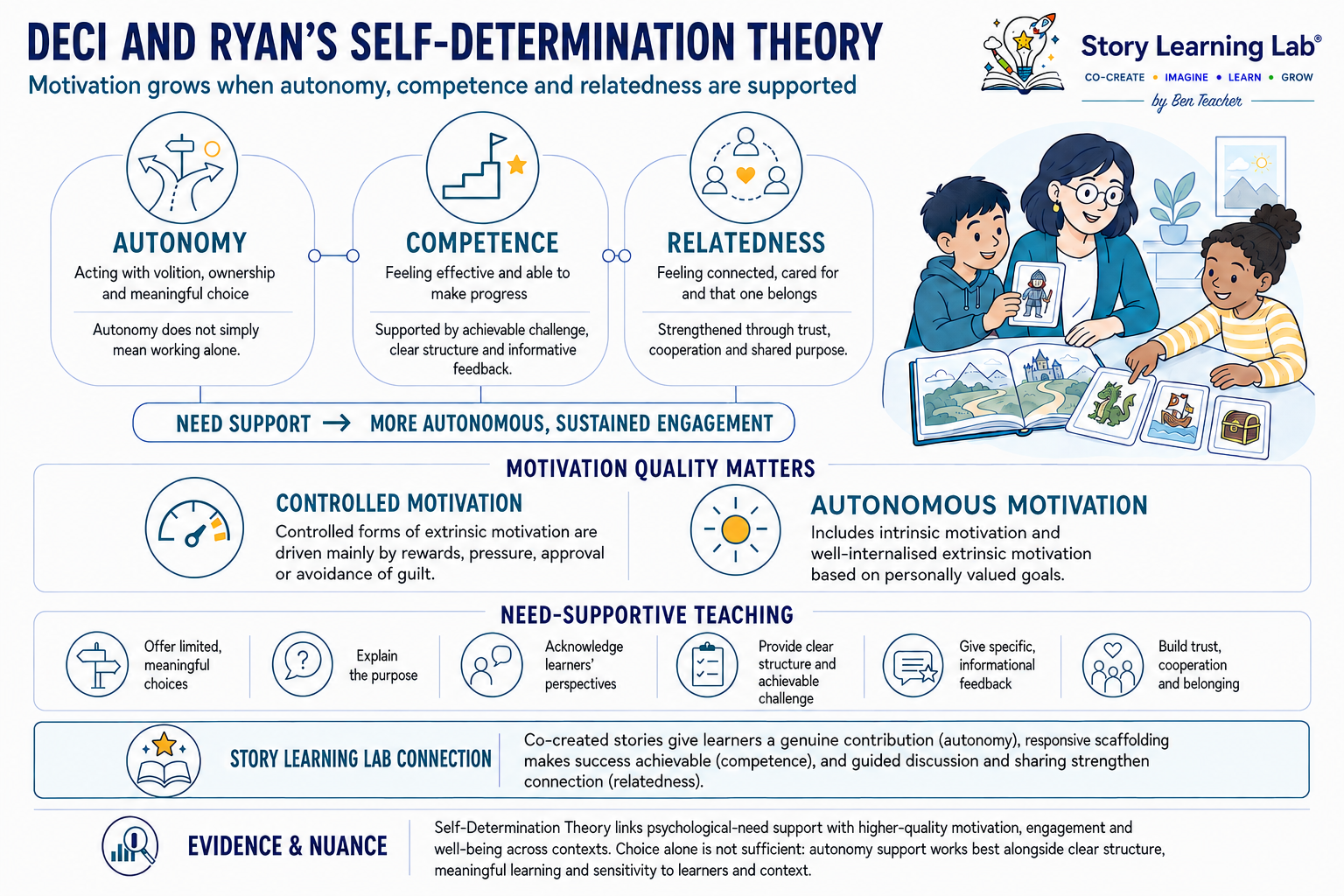
Edward Deci and Richard Ryan’s Self-Determination Theory explains how autonomy, competence and relatedness support motivation, engagement and well-being.
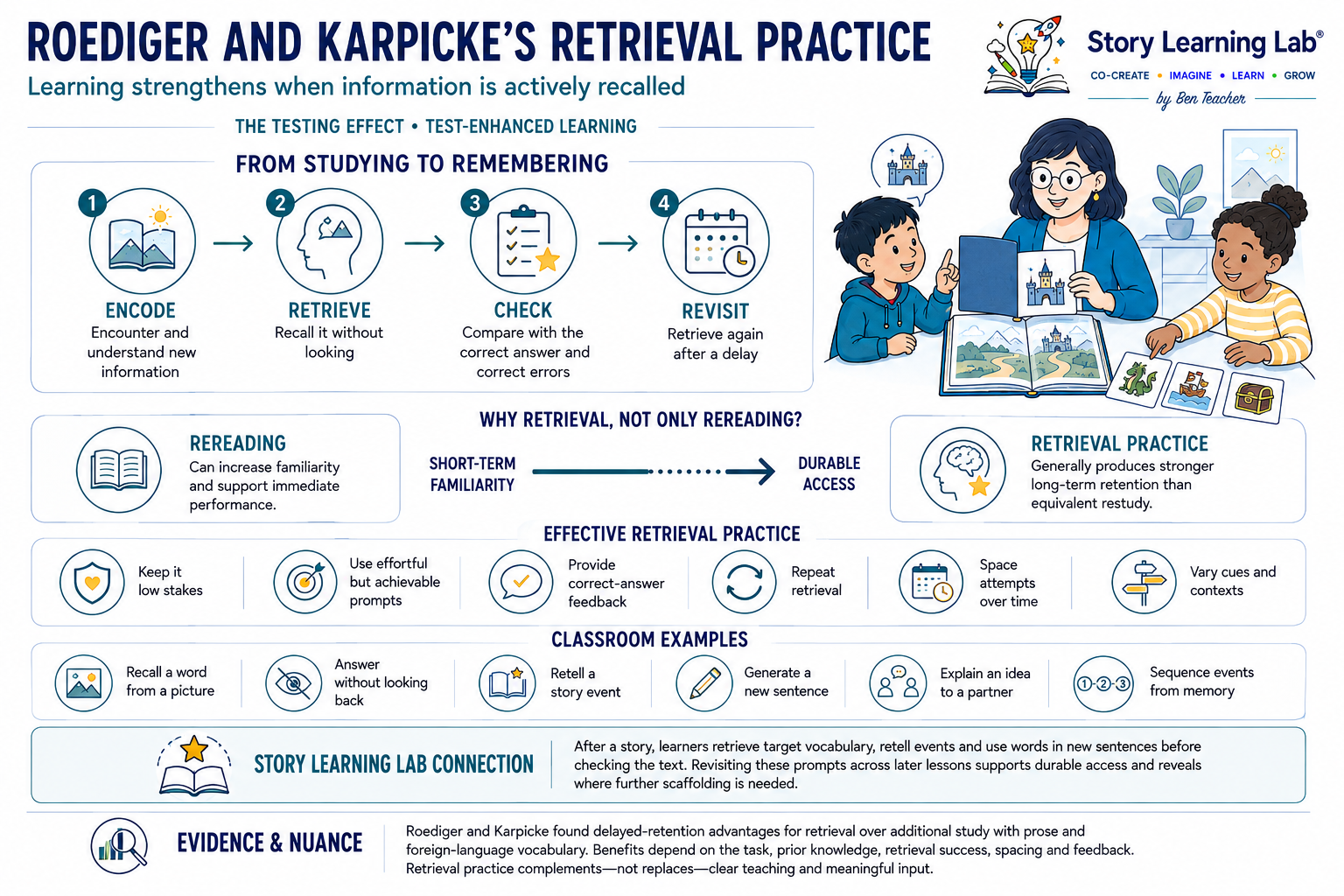
Henry Roediger and Jeffrey Karpicke’s research demonstrates how actively retrieving information can strengthen long-term retention more effectively than rereading alone.
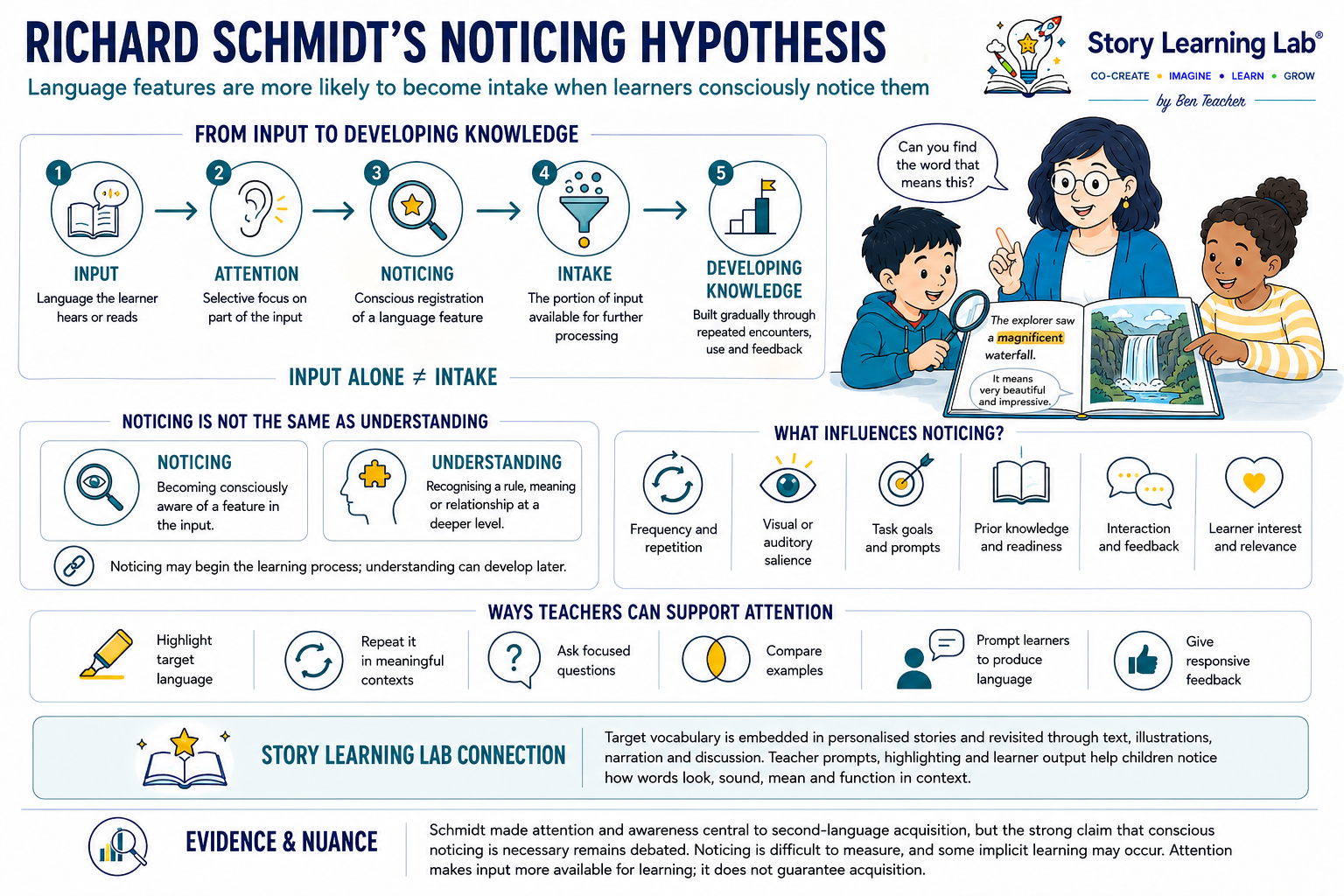
Richard Schmidt’s Noticing Hypothesis highlights how conscious attention can help language input become available for learning as intake.
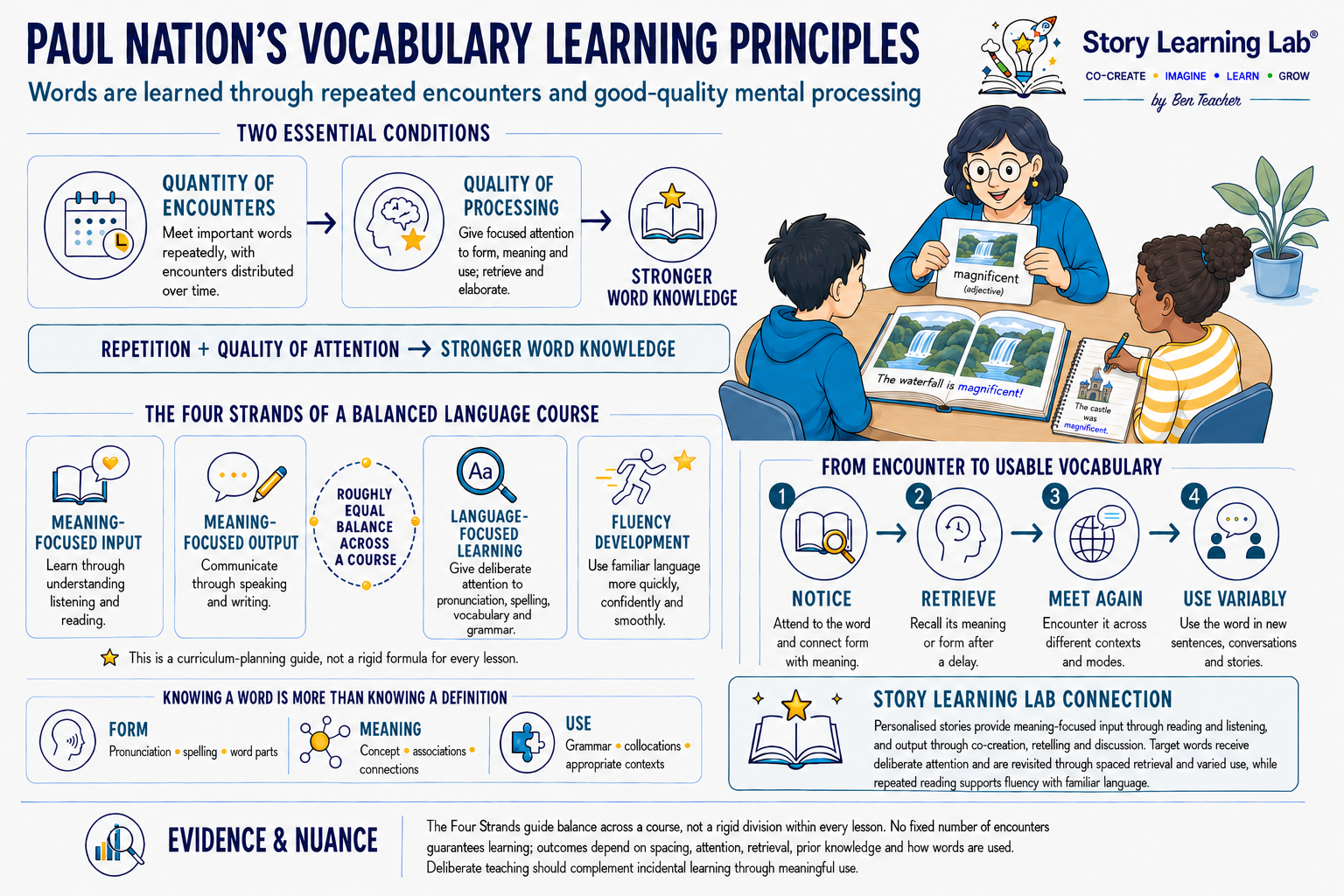
Paul Nation’s work explains how vocabulary develops through repeated encounters, focused attention, retrieval and meaningful use within a balanced language course.
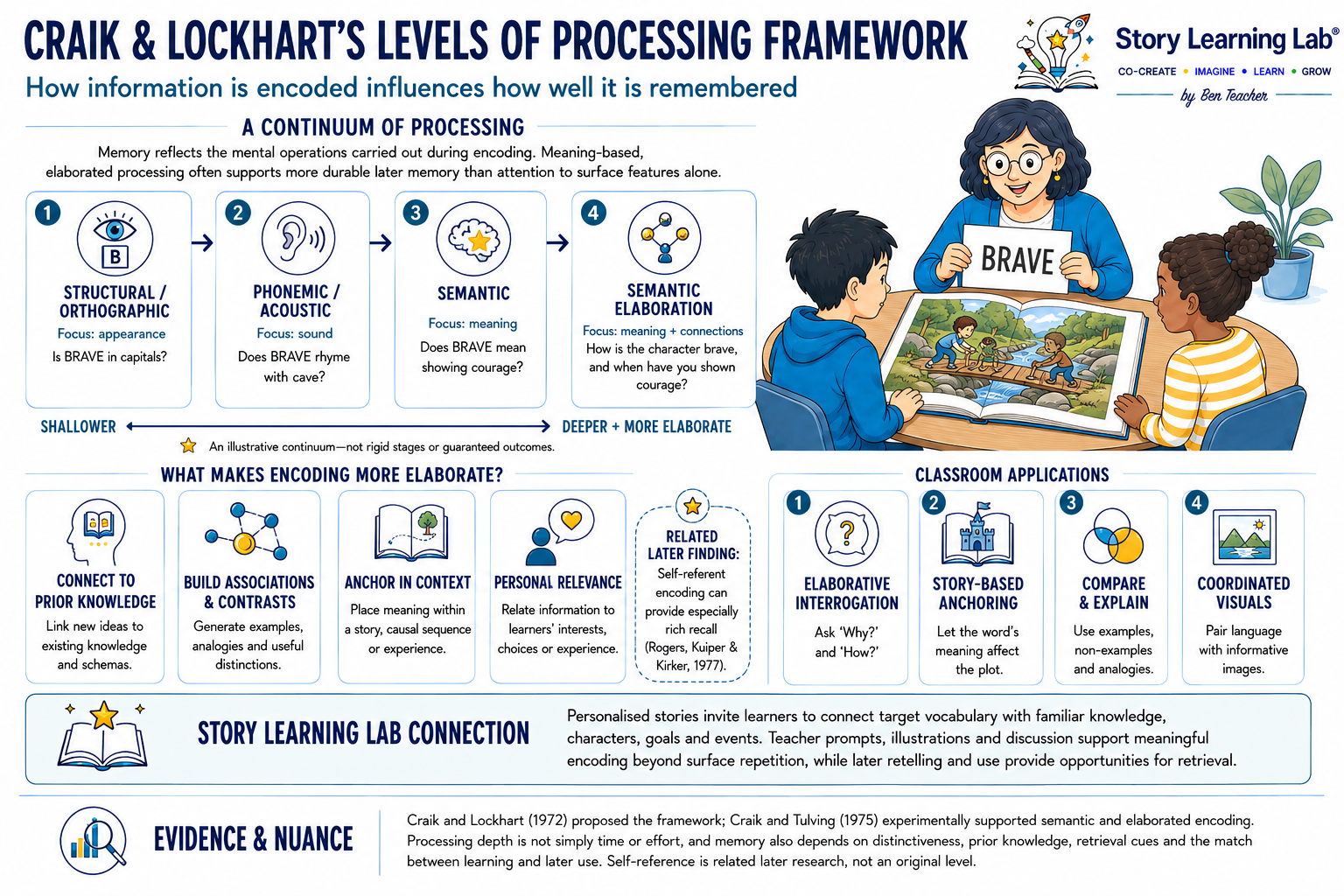
Craik and Lockhart’s Levels of Processing framework (1972), posits that deeper semantic processing creates richer memory traces, leading to significantly higher retention and retrieval strength.
A research-informed overview
Philosophies of Education
Different traditions offer different answers to four central questions: What is knowledge? How does learning happen? What is the teacher’s role? What is education for?
Knowledge & reality
Learning & experience
Person & society
Knowledge & reality
Idealism
- Representative thinkers
- Plato, Immanuel Kant and G. W. F. Hegel
- View of knowledge
- Reasoned understanding centres on ideas, values and enduring intellectual or ethical questions.
- How learning happens
- Learners develop through dialogue, reflection, disciplined study and the examination of ideas.
- Teacher’s role
- An intellectual and ethical guide who introduces important traditions and questions.
- Classroom expression
- Socratic dialogue, close reading, conceptual analysis and discussion of ethical dilemmas.
Story Learning Lab connection: Its emphasis on dialogue and meaning is relevant, although Story Learning Lab grounds language development in experience, interaction and empirical research.
Knowledge & reality
Realism & empiricism
- Representative thinkers
- Aristotle, Francis Bacon and John Locke
- View of knowledge
- A world beyond the learner can be investigated through observation, evidence and reason.
- How learning happens
- Learners examine facts, patterns, causes and relationships, connecting perception with explanation.
- Teacher’s role
- A subject expert who structures accurate encounters with knowledge and evidence.
- Classroom expression
- Observation, classification, demonstrations and evidence-based explanations.
Story Learning Lab connection: Accurate word meanings, coherent contexts and careful observation support the approach’s evidence-informed language teaching.
Knowledge & reality
Postmodern perspectives
- Representative thinkers
- Michel Foucault, Jacques Derrida and Jean-François Lyotard
- View of knowledge
- Universal claims are questioned, with attention to how language, discourse and power shape what counts as knowledge.
- How learning happens
- Learners compare interpretations, uncover assumptions and notice which perspectives are present or absent.
- Teacher’s role
- A facilitator of interpretive inquiry and critical reading rather than a single final authority.
- Classroom expression
- Perspective shifts, alternative retellings and careful examination of language and representation.
Story Learning Lab connection: Multiple viewpoints can enrich story discussion, provided activities remain accessible and developmentally appropriate for young learners.
Learning & experience
Behaviorism
- Representative thinkers
- Ivan Pavlov, John B. Watson and B. F. Skinner
- View of knowledge
- The tradition focuses on observable performance and the environmental conditions that shape behaviour.
- How learning happens
- Cues, practice, consequences and reinforcement alter the likelihood of responses.
- Teacher’s role
- Sets clear objectives, sequences practice and provides timely, consistent feedback.
- Classroom expression
- Modelling, guided practice, immediate feedback, routines and reinforcement.
Story Learning Lab connection: Structured repetition and feedback can support practice, but Story Learning Lab also depends on meaning, cognition, interaction and learner agency.
Learning & experience
Pragmatism & progressivism
- Representative thinkers
- William James, John Dewey and Jane Addams
- View of knowledge
- Ideas are tested, refined and judged through inquiry, experience and their consequences in context.
- How learning happens
- Learners act, investigate, solve problems, communicate and reflect on the results.
- Teacher’s role
- Designs meaningful problems and supports a collaborative, democratic learning community.
- Classroom expression
- Projects, experiments, authentic tasks, discussion and reflection.
Story Learning Lab connection: Personalised story creation lets children use language to solve communicative and narrative problems with meaningful outcomes.
Learning & experience
Constructivism & sociocultural theory
- Representative thinkers
- Jean Piaget, Lev Vygotsky and Jerome Bruner
- View of knowledge
- Understanding is actively organised through prior knowledge, experience and socially mediated cultural tools.
- How learning happens
- Learners connect, test, revise, discuss and represent ideas with responsive guidance.
- Teacher’s role
- Elicits prior knowledge, scaffolds participation and gradually reduces support as competence grows.
- Classroom expression
- Prediction, story co-creation, dialogue, visual support, role play and retelling.
Story Learning Lab connection: This is a central foundation: learners co-construct personalised stories while teachers guide attention, language use and increasing independence.
Person & society
Humanism & self-determination
- Representative thinkers
- Abraham Maslow, Carl Rogers, Edward Deci and Richard Ryan
- View of knowledge
- Education concerns the whole person, including agency, relationships, confidence, values and well-being.
- How learning happens
- Meaningful engagement is supported when learners experience autonomy, competence and relatedness.
- Teacher’s role
- Creates a safe, responsive and well-structured environment while supporting meaningful choice.
- Classroom expression
- Learner interests, achievable challenge, reflection, collaboration and supportive feedback.
Story Learning Lab connection: Personalisation and collaborative storytelling can support ownership, competence and connection without removing teacher guidance.
Person & society
Existentialism
- Representative thinkers
- Søren Kierkegaard, Martin Buber and Jean-Paul Sartre
- View of knowledge
- Meaning is personally lived and chosen amid freedom, responsibility, relationships and uncertainty.
- How learning happens
- Personal engagement, authentic encounter, reflection and consequential choice are central.
- Teacher’s role
- Invites serious dialogue and choice without prescribing every interpretation or personal meaning.
- Classroom expression
- Reflective writing, open questions, personal interpretation and discussion of responsibility.
Story Learning Lab connection: Learner-generated characters, dilemmas and choices can strengthen personal meaning and ownership within a supportive structure.
Person & society
Critical pedagogy & reconstructionism
- Representative thinkers
- George Counts, Theodore Brameld, Paulo Freire, bell hooks and Henry Giroux
- View of knowledge
- Knowledge and curricula are shaped by culture, social conditions and power rather than being entirely neutral.
- How learning happens
- Dialogue connects reflection with questions about lived experience, society and possible action.
- Teacher’s role
- A responsible co-investigator who supports safe, rigorous inquiry rather than treating learners as passive recipients.
- Classroom expression
- Multiple perspectives, critical literacy and projects connected to meaningful social questions.
Story Learning Lab connection: Learner voice and dialogue align with the approach, although Story Learning Lab is not presented as a specific political programme.
These labels simplify complex, overlapping traditions. Contemporary teaching commonly combines ideas from several perspectives.
Why Personalised Storytelling Works
At the heart of the Story Learning Lab© is a simple idea: language is not only memorised, it is experienced. Through teacher-guided, AI-generated stories tailored to each learner’s interests and experiences, language becomes more meaningful, engaging and memorable.
1. Lowering the Affective Filter
Language learning can feel intimidating, particularly when learners are worried about making mistakes. Familiar characters, interests and experiences help create a supportive environment in which students feel more comfortable participating, experimenting with language and expressing their ideas.
2. Creating Narrative Anchors
Vocabulary encountered in isolation can be difficult to retain. Stories provide meaningful “narrative anchors” by connecting new words to characters, events and emotions. When learners encounter vocabulary within a story that reflects their own experiences, they develop richer associations that can support understanding and long-term recall.
3. Strengthening Recall Through Dual Coding
Story Learning Lab sessions combine verbal information, such as written and spoken language, with visual elements, gestures and familiar personal contexts. This multimodal approach gives learners several ways to process and retrieve new vocabulary, reinforcing both comprehension and recall.
4. Moving from Passive to Active Learning
Rather than simply receiving information, students help shape the narrative. They may contribute characters, settings, interests or plot ideas and then see those contributions developed into a complete story. This sense of ownership encourages learners to read closely, discuss ideas and use new language with purpose.
5. Using Emotional Relevance to Support Memory
Personally meaningful content naturally attracts attention. A story featuring a learner’s favourite hobby, an imaginative character or a familiar cultural setting can create an emotional connection that encourages deeper engagement. The goal is not simply to teach individual words, but to place language within experiences learners will remember.
Classroom Impact
In my classroom research, personalised storytelling was associated with high levels of learner engagement and a strong sense of ownership. By inviting learners to co-create narratives, the sessions created repeated opportunities for three learning-related developments:
Growing Fluency and Reading Confidence
As their stories became familiar, learners read with fewer pauses, anticipated repeated words and lines, and demonstrated greater confidence. These behaviours suggest that repeated reading supported smoother oral reading, although fluency was not assessed separately.
Deeper Vocabulary Knowledge
Embedding target words within meaningful, personalised narratives supported repeated attention, retrieval and contextualised use. The intervention group showed its clearest gains in semantic understanding and sentence production rather than simple recognition.
Active Participation and Increasing Independence
Learners contributed ideas, negotiated story meaning, discussed vocabulary and shared their stories with peers. Teacher mediation gradually decreased as learners became more familiar with their texts and assumed greater responsibility.
Indicators of engagement and ownership were especially visible when learners contributed their own characters, settings and events and later shared the completed stories. Seeing their ideas represented in stable, revisitable texts encouraged pride, enthusiasm and a willingness to participate.
These findings are indicative rather than causal because the study involved a small, non-randomised sample over a four-week period.